Energy water challenges drive Mexico data center expansion
Development of data centers in Mexico demands capital outlays that exceed those for typical industrial warehouses, and it requires specialized planning that accounts for client specifications, power and water availability, cooling methods, and future expansion potential.
From a legal standpoint, authorities must examine energy supply contracts, water resource rights, land tenure, especially to avoid ejidal disputes, while also considering tax incentives and compliance with data-protection regulations.
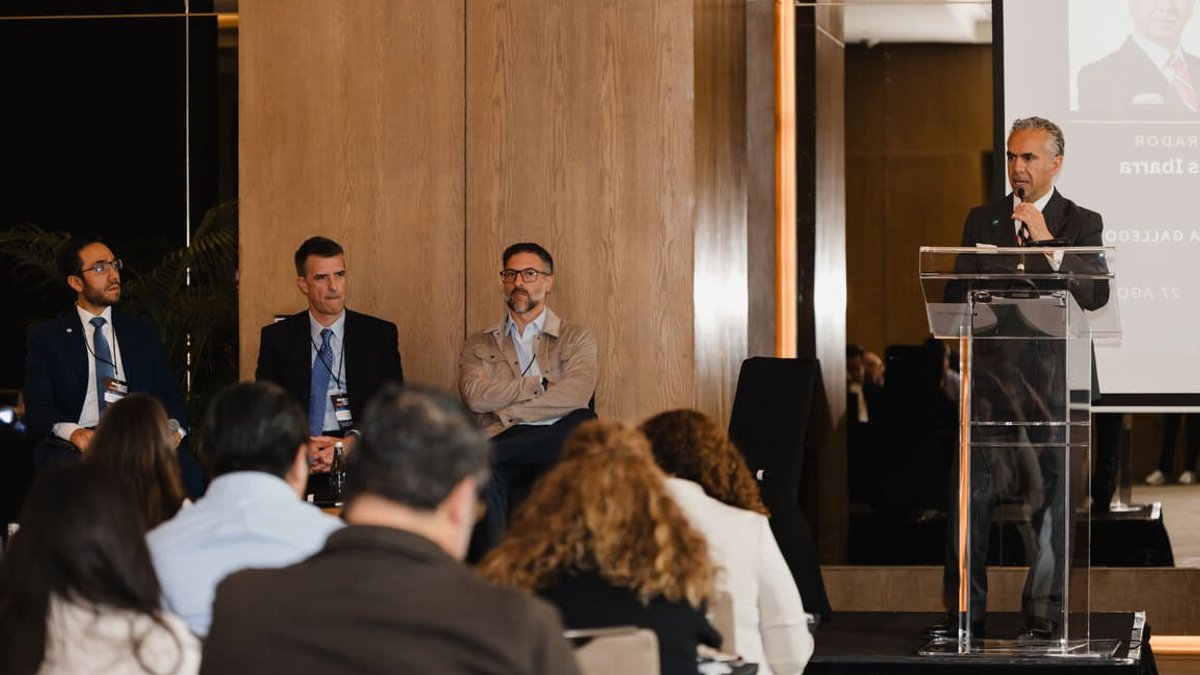
Panel at the Industrial & Logistics Summit 2026
The discussion was moderated by Carlos Ibarra of Ibarra Gallego, featuring Andrés García Fajer of KIO Data Centers, Javier Jiménez Nájera of Johnson Controls, and David Oliver Mader of Industrial Solutions.
García Fajer emphasized that “investing in data centers requires a capital premium compared with a traditional industrial warehouse, which forces developers to understand the client’s margin expectations, pricing strategy, and projected intensity to select the optimal infrastructure.” The speaker’s remarks highlighted the financial discipline required for such projects.
Querétaro’s rise as a data-center hub
The city became a hub almost by chance, after the inauguration of the first facility attracted carriers, suppliers, and a growing pool of skilled labor, gradually positioning it as a strategic location for further projects.
He noted that the timing aligned with market demand, giving the region a privileged status that now draws both operators and developers seeking space.
Jiménez Nájera added that the location serves as a key link between Mexico City and Texas, noting that it “is no longer a satellite city; it has its own established capabilities, infrastructure, and industry, and will remain a magnet for contemporary industrialization.” His comments reflected the growing strategic importance of the region.
Mader highlighted that each project is essentially a built-to-sit venture, requiring a clear understanding of the client’s technical profile before identifying the appropriate solution.
Technically, a data-center functions as a building where electricity is introduced, heat is generated, and temperature must be maintained, which can be achieved through electric chillers, water-based systems, or alternative methods.
Jiménez Nájera warned that power-related challenges must be assessed from the project’s inception, taking the ongoing water and energy crises into account, and he urged developers to engage designers for a thorough review.
He cited the local water shortage as a reason why evaporative cooling is impractical in the region, suggesting that exhaust gases could instead feed a cogeneration turbine to provide cooling without depleting scarce water supplies.


